
Blog
Program Spotlight: Prescribe Outside gets Phily children outdoors via nature prescriptions!
August 9, 2026
This month, our program spotlight looks at Prescribe Outside, a nature prescription program based in Philadelphia. It is a partnership between Children’s Hospital of Philadelphia (CHOP), Awbury Arboretum, Let’s Go Outdoors, the USDA Forest Service, and Temple University Center for Sustainable Communities. The goal of the program is to provide physicians and families with tools to improve the health and wellness of Philadelphia children by helping them locate and use safe, accessible, and convenient public green space and discover the benefits of time spent in nature. This is an interview with Grace Parker, M.S., the organization’s Program Director,.
1. Briefly describe your social prescribing program and the communities it serves.
Prescribe Outside convenes a network of diverse partners who understand the health benefits of nature and the outdoors and believe that it should be accessible to all people. The partnership trains and supports Philadelphia pediatric and family health providers in prescribing nature to their patients who are able to safely access nature and the outdoors for improved health. The Partnership prioritizes support to communities with a lack of access to greenspace within the Greater Philadelphia Area.

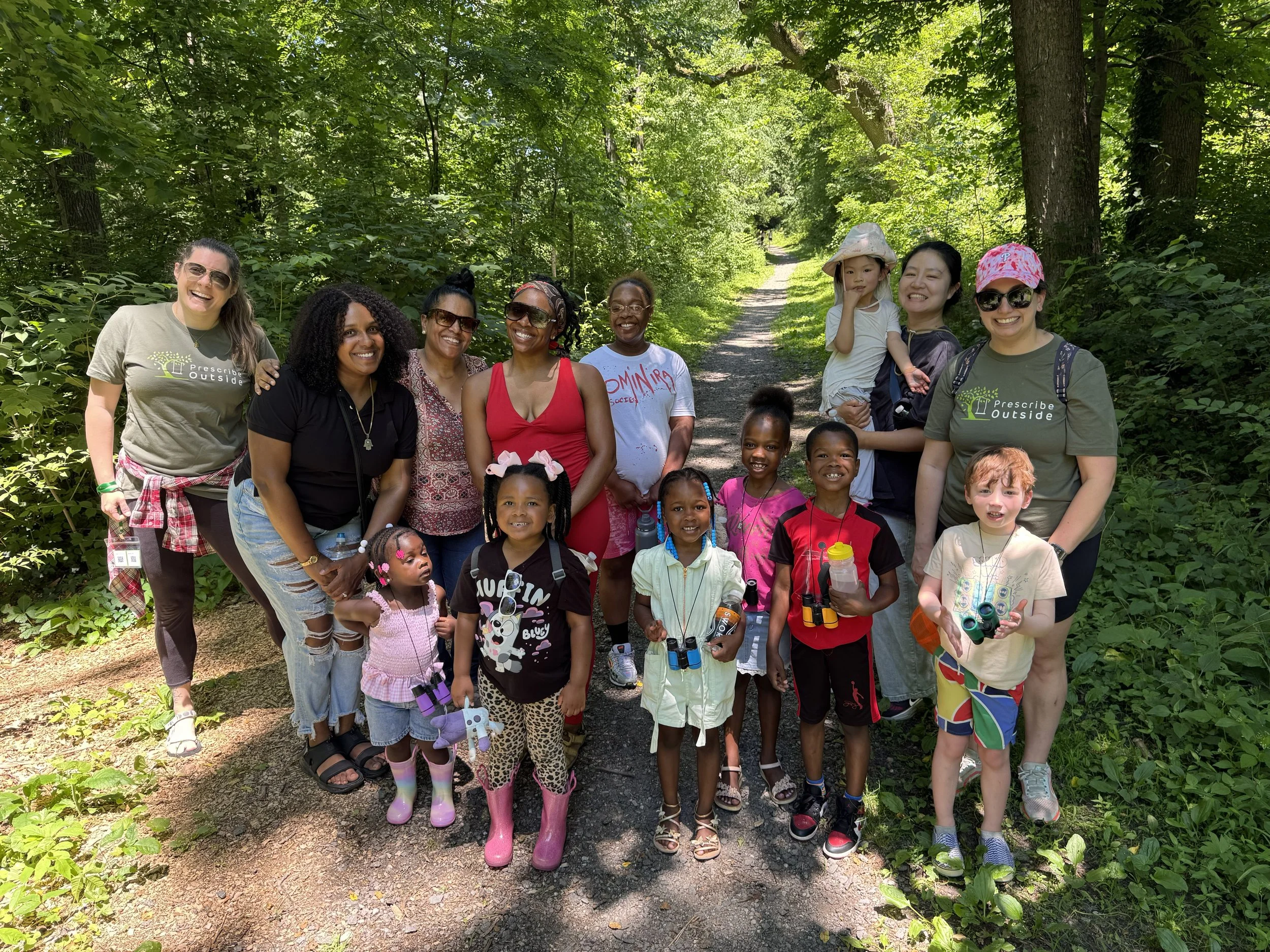
With Awbury Arboretum serving as the land steward partner and home base of program management and external communications, each of the supporting partners contribute in unique ways. Children’s Hospital of Philadelphia (CHOP) serves as the primary healthcare partner with pediatricians from 7 of the 30+ sites within the Primary Care network prescribing time in nature. Upon receiving a nature prescription, families are prompted to select a family-friendly program from www.prescribeoutside.org. All programs are free and open to the public and are facilitated by Lets Go Outdoors, a locally owned business whose mission is to connect city communities to outdoor experiences, and the Sierra Club PA Chapter’s Outdoors for All campaign. Outdoor programs generally fall within three tracks: Active (i.e. hiking), Passive (nature crafts), and Mindfulness (i.e. yoga). Once a family has participated in a program, Temple University's Center for Sustainable Communities in conjunction with the USDA Forest Service work to understand the family experience, motive, and barriers to participation when applicable.
2. Who makes referrals to your program and what are the qualifying criteria to be referred?
While the majority of current referrals come from pediatricians during wellness visits, we are developing tools to allow nurses, social workers, community health workers, and specialty care providers to participate. Of the 30+ primary care sites within CHOP, our program has prioritized the 7 clinics serving patient populations with the highest need for green space access, all of which are within or just beyond Philadelphia city limits. While all children benefit from time spent outdoors, patients exhibiting symptoms of mild anxiety or depression, issues with attention or focus, or physical deconditioning are identified as being in high need. This stems from an ever growing body of evidence that suggests nature’s positive impact on stress, heart health, focus, and overall mood.
3. Who serves as the connector and what does their role entail?
Established at CHOP in April 2026, the Nature Prescription Coordinator (NPC) role currently functions in 2 of the 7 prescribing primary care sites, though we hope the role will one day become standardized across the primary care network. Once a provider makes a referral within the patient’s chart, the NPC is prompted to engage the patient's family, ideally before leaving the site and otherwise through a follow-up call. The family is invited to participate in an multi-step incentivized process that focuses on identifying potential opportunities for green space access.
4. How has social prescribing impacted the health and well-being of the people you serve and which outcome measures do you use to measure that impact?
Presently, our metrics focus on how to best serve communities within Philadelphia. Historically, our partners through Temple University and the USDA Forest Service have developed IRB-approved survey studies to understand both participant experience with the program as well as non-participant (those who signed up, but did not follow through with a program) barriers to participation. Similarly, we have also surveyed healthcare providers to understand how to best support them in prescribing nature (i.e. develop new tools, adjust communications methods). Fortunately, the addition of the Nature Prescription Coordinator role should address themes identified in those surveys, which will facilitate a higher rate of nature prescription fulfillment.
Looking forward, we hope to evolve our Nature Prescription Coordinator role to become more research-based, with the ability to track participating patients over time and potentially track select biomarkers. The ability to work directly with patient families cannot be understated when observing behavior change over time.
5. How is your program funded?
Currently, our program is entirely grant-funded, though we are beginning to explore grass-roots fundraising and corporate sponsorships to diversify our support systems. We have been especially fortunate to have secured support for project management, communications, programming, and for our two NPCs through the Pennsylvania Department of Conservation and Natural Resources’ Community Conservation Partnerships Program Grant.
In addition to the wide range of skill sets shared amongst the partner organizations (and in most cases provided in-kind), each partner within the organization is involved in the identification of internal and external funding opportunities. For example, with CHOP’s position as a community-centered non-profit, there are multiple internal initiatives throughout the enterprise that are dedicated to improving quality of life for residents in the Greater Philadelphia Area. Prescribe Outside has been fortunate to collaborate with and be supported by initiatives through CHOP’s Office of Community Impact, Center for Violence Prevention, Center for Health Equity, and Integrative Health Program. Similarly, the USDA Forest Service has previously facilitated Cooperative Agreements as well as strategic and communications planning guidance through the National Park Service Rivers, Trails, and Conservation Assistance program.
In the spirit of Prescribe Outside’s desire to standardize the role of nature prescriptions in pediatric medicine, we are also exploring potential sustainability opportunities through health insurance billing codes. To date, we have yet to secure that pathway as a viable funding framework, though we hope our work will contribute to the growing body of research demonstrating the value of nature as a preventive health measure.
6. What advice would you give to others looking to start a social prescribing program?
Take your time and make friends. As a consultant once advised us, “progress moves at the speed of trust.” While funding and influence are without a doubt valuable tools to have at your disposal, you will make little headway without community buy-in. Philadelphia is a great example of a diverse and multi-cultural city with a history steeped in inequity, especially as it relates to access to quality greenspace. Fortunately, there are a number of initiatives, both within and beyond Prescribe Outside, currently aiming to address this. Connecting the dots, building relationships, changing perceptions – all of this takes time. Fortunately, playing the long game is much easier when you have passionate and committed partners by your side.
Image above provided by Prescribe Outside.